It can seem incredibly daunting to start your fertility journey as an LGBTQ+ family. People will have their opinions about your life choices and you’ll soon be confronted with conflicting critiques from all sides. That being said, we’re here to offer our unbiased experience to help lighten the load.

‘What options are available to us?’
When we first started our journey, we were completely lost with all of the different processes that we could go through to get our baby. IVF, ICSI, IUI – acronyms that were seemingly out of reach for us to understand, encased behind a wall made for heterosexual couples. Google was not our friend.
Everywhere you look online, information and advice is geared towards people in cis-gender, hetero-normative relationships who are experiencing difficulties in conceiving. While this is a sensitive subject, and my heart goes out to those who are struggling, the advice wasn’t (thankfully) relevant for us.
Just for ease, here’s a brief rundown of the main two types of fertility treatment that are available for lesbian couples in complete layman’s terms:
- Conventional IVF – Eggs are removed from ovaries, fertilised with sperm and placed back inside uterus at optimal time. Generally, heavy medication and sedation required for the egg collection.
- IUI – A less invasive process wherein sperm is injected directly into the uterus to make sure it gets where it should. The old ‘Turkey Baster’ is a less medical IUI of sorts.
Within these two umbrellas, there are a variety of options to shake things up.
Our exploration of the different options led us to a specific type of IVF that we felt was perfect for us – Reciprocal IVF, or Shared Motherhood.
Reciprocal IVF is the process wherein a lesbian couple can both have an active part in producing a baby. One partner has stimulation of their ovaries to produce multiple eggs which are then extracted under sedation and then fertilised with donor sperm. Once the eggs are fertilised, they are left to develop for a few days – usually 5. By day 5, an embryo should be formed and can then either be transferred fresh into the other partner’s uterus, or frozen for use at a later date.
‘Where should we go?’

Finding a clinic is one of the first roadblocks you’ll hit as a couple. There are a huge amount of private clinics around the world that can help you with your family goals, for a price. Treatment is, in the UK, available on the NHS but this usually involves hefty waiting times.
For that reason, we chose to go private. We realise that this is not an option for all families, and that we were incredibly lucky to be able to fund it ourselves.
In searching for the right clinic, we wanted a couple of things. Namely, somewhere not too far from us as we’d heard that there’s a lot of travelling to and from; secondly, we didn’t want a clinic that plied you with excessive drugs. We’d heard horror stories of women hospitalised for OHSS (Ovarian Hyper-Stimulation Syndrome).
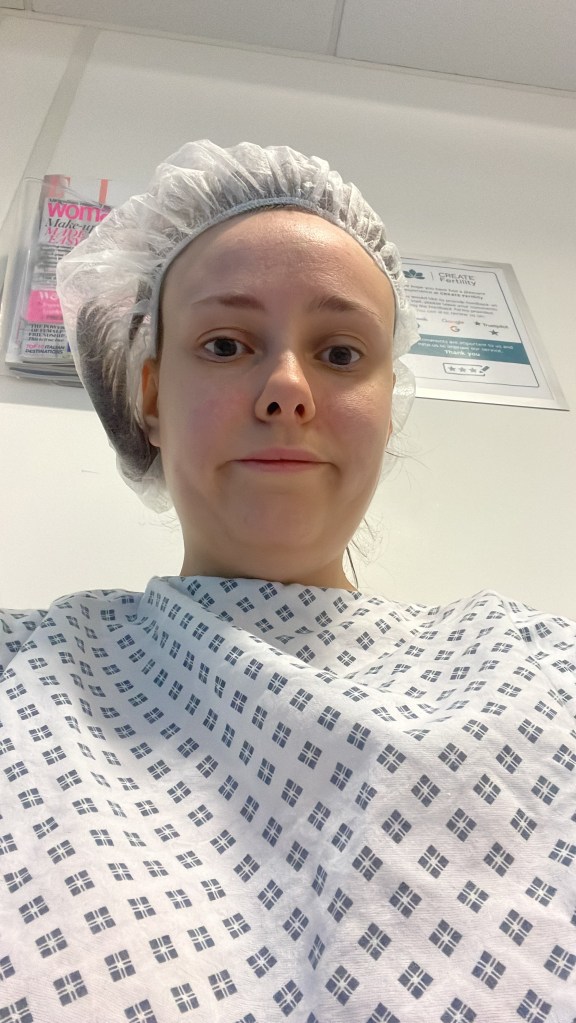
We then came across Create Fertility – a company who specialise in a relatively new form of IVF called ‘Mild IVF’. The emphasis here is less on quantity, and more on quality. They use less drugs to produce less eggs with the belief that the eggs produced tend to be of a better quality. Mild IVF also reduces the risk of OHSS, and therefore shortens the length of the process.
It seemed like a ‘no-brainer’. The company specialised in Mild IVF, offered Reciprocal IVF and at a lower cost than any other clinic we had looked at.
‘Well, what’s the downside?’
We said, when we started this blog that we were going to be honest throughout. There are risks associated with Mild IVF – not health risks, but a lower success rate compared to conventional IVF. This is down to the simple fact that you don’t have as many eggs to work with. For us, we managed to get 8 eggs extracted, and 4 fertilised. 2 made it to Day 5. These numbers may seem daunting – they were for us, too. All the clinic kept telling us was that it only takes one.
Ultimately, independent exploration is the way to go when starting out. Look at people’s experiences, check out (impartial) medical journals and visit some clinic websites. While it was stressful, we did enjoy getting to hear about all of the wonderful IVF stories that lesbian couples have shared.
It’s time to start writing your own story, what are you waiting for?




 Two Mamas, One Baby